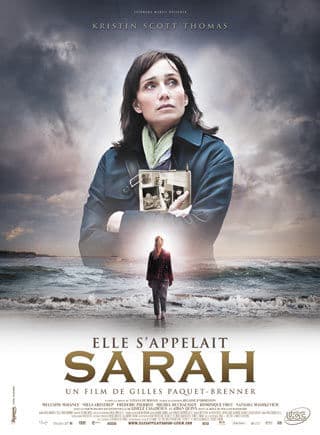
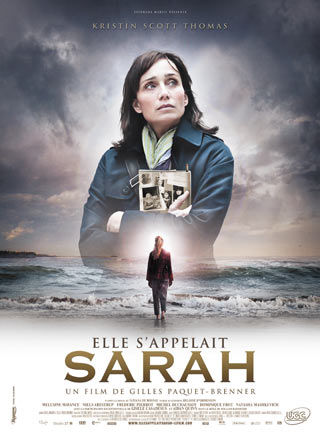
We went to see “Sarah’s Key”…
Of course, the images shook me from the very beginning. Of course, I felt a knot form in my stomach and stay there… of course.
But when I get this overwhelmed, my critical judgment tends to go out the window. That’s why, afterward, I can feel a little doubt creeping in… Did this film really go where we expected it to? Does it add anything to the work France and the French are doing to remember their past? All these questions, and others besides, give me pause. So today, HE’s taking up the pen to give us his take on it all…
What do we do with memory, that unstable, flammable, sometimes explosive stuff? Cast it into the depths of oblivion, patiently tend it like a wildflower, preserve it like a relic, or pick it apart until we draw out nourishing sap one time and deadly poison the next? That, at heart, is what “Sarah’s Key” is about.
Victims, perpetrators, accomplices, and distant witnesses to the tragedy cross paths and ultimately run up against the same nagging questions. What do we do with the past our lives are woven from? How do we balance what we need to forget with what we must remember, so we can find the strength to make our own way?
The story: Christine Scott-Thomas plays an American journalist married to a Frenchman whose grandparents moved into an apartment in le Marais in August 1942, after the Jewish family who lived there was rounded up by the Vichy police. Except tha the French father then discovers little Michel’s lifeless body along with Sarah.
The investigation takes our American journalist from Paris to Florence by way of Brooklyn. To track down this ghost from a past that isn’t even hers, she risks upending her orderly life, her marriage, and her family.
It doesn’t take long before you’re in tears. The horror of such ordinary violence, so utterly senseless in its blindness and stupidity, sends shivers down your spine. The parallel stories, sixty years apart, echo each other. And yet… the more hours go by after you leave the theater, the more the questions pile up and the unease sets in. Swept up in an entirely understandable wave of emotion, you don’t notice at first how the sentimentality and clichés of a tearjerker take over the story and drain the life out of it.
Did it really take an American, even one in love with Paris, to dig up France’s ghosts and offer herself up as a sacrifice to atone for the shame? Was the dogged-journalist routine really the only way to get at the truth?
And then there are the predictable images of a doomed bid for forgiveness. America as easy redemption for a Europe mired in its past. France is guilty, but the French are innocent: apart from one nasty concierge, the guilty parties are all anonymous, while everyone who actually does anything in this film is an everyday hero: the apartment’s new occupant, who sends Sarah to the Free Zone and provides for her; the camp guard, who lets her eat an apple and then escape; the surly farmer, who takes her in as his own daughter. How could such a bighearted people have produced Vichy and the Vel d'Hiv?
In the end, the genuinely moving moment is the archival footage of Jacques Chirac’s speech, when he finally, five decades too late, simply acknowledges France’s responsibility.
And then there are all the lies, as if no one could bear to hear the truth. The French family that thinks denial will protect them, Sarah trying to forget who she is until she takes her own life, her husband keeping silent right up to his deathbed, her son finding out at fifty that his life is a lie—a realization that’s sadly common enough, even among people who don’t have a family secret to carry. A tangle of secrets that no doubt serves the plot but ultimately puts everything on the same level.
And finally, there’s that strange story of a miracle baby who comes along after all hope is gone and blows up the American journalist’s marriage. It feels a little too neatly contrived: this journey of discovery has to end with the birth of a little Sarah, artificially carrying on a family that really did go up in smoke somewhere on the plains of Poland. An odd collision of a name and a fate. The journalist, who thought she was too old to have a child, welcomes the miracle of life, like Sarah, Jacob’s wife.