Dieu qu'ils étaient lourds
Le Lucernaire
53 rue Notre-Dame des champs, 75006 Paris.
Main number: 01 42 22 26 50
We discovered this place not long ago: theater, movies, a bookstore—culture takes all kinds of forms here ... And you can grab a bite right there, too!
We were sold!
So here’s HIS review, which is as much about this unusual venue as it is about the play!
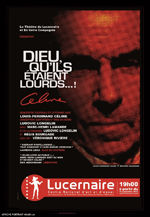
Dieux qu’ils étaient lourds.
First, you have to wait at the foot of a slightly rickety spiral staircase. There aren’t many of us, a few dozen at most, so you get the chance—or feel the urge—to look at the other people here for the show, unlike in big theaters where everyone blends into one anonymous crowd. A little metal chain blocks the stairs, and a smiling young usher keeps watch. This young guardian of the place tells us we’ll climb up to Paradis at 7pm sharp and that we’ll need to keep quiet on the way up. Other shows are going on downstairs. Will we pass through purgatory?
The aptly named theater is tucked under the eaves of Le Lucernaire, a cultural venue that’s part theater, part movie house, part bookstore, part restaurant ... So up we go toward heaven in reverent silence—you have to earn your way into paradise—but it’s no use: the wooden boards creak and squeak underfoot. The damned on the floors below will just have to put up with the racket as we pass. And then, at last, the deep darkness of Paradis welcomes us in. We take our seats on L-shaped bleachers that wrap around the stage. A mysterious voice tells us that the emergency exit is behind the big black curtain at the very back of the room. That’s when you realize you’re not in front of the stage here. You’re on it.
An old song from a last-century phonograph slowly fills the silence. Then comes a gravelly voice that grows bolder as it goes, now cynical, now gleeful. The remarks are muddled at first, then nostalgic, bitter, dark, mean, disillusioned, funny. Bursts of resentment, like the last poisoned arrows of a man who takes gleeful refuge in being misunderstood by his contemporaries and turns that misunderstanding into glory.
What’s left of his life as the journey draws to a close and the end of the night comes into view? “It’s all just human ugliness that a little sand can wipe away.”
Answering questions in an unlikely interview, Céline—for it’s him, the great writer both admired and reviled—Céline, then, defends his style. Right to the end, he insists that form trumps content, that words matter more than ideas. The right words, great style—not the jumble churned out by so-called literary writers, but the kind of style you come across only once or twice in a generation. Céline fights back, refusing to concede or confess anything to his critics. No remorse, few regrets. Just a writer in search of a certain purity, a certain perfection, at the risk of that purity turning into a “dangerous purity.”
In the spirit of the misanthrope of Meudon’s last work, “Conversations with Professor Y,” the play draws on excerpts from radio interviews Céline gave in the late 1950s. Marc-Henri Lammande is dazzling. What a joy to see and hear an actor, a real stage actor, instead of TV stars floundering pitifully in roles they can’t handle. It rings true, and it’s moving. For a moment you forget you’re in a theater with your butt on a wooden bench, you forget the few dozen people around you, and you imagine yourself beside a crackling fire, lucky enough to be there, trading deep thoughts and memories of life with a legend, a literary “monster.”
God, that hour flew by.