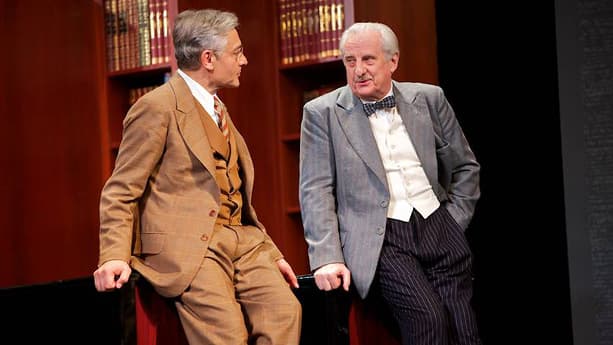
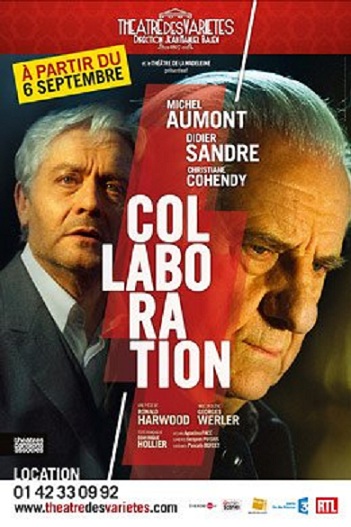
Collaboration – Michel Aumont and Didier Sandre
A promising story and a promising cast.
Didier Sandre and Michel Aumont play Stéphan Zweig and Richard Strauss, respectively, telling the story of their friendship and their collaboration on “The Silent Woman,” a comic opera inspired by Ben Johnson that they created together in 1935.
The action starts in 1931 and ends in 1942, with a scene foreshadowing the suicides of Zweig and his second wife, Lotte.
We watch the relationship between the two men evolve, along with the positions they take as the political landscape shifts around them. There’s Strauss, close to the German government and comfortable in his fame, and then there’s Zweig, who sees the horror looming over Europe and the rest of the world.
I don’t know Strauss’s work or the man himself all that well, so it’s hard for me to judge how he’s portrayed or what he’s made to say and do. Still, his closeness to the Nazi regime is barely mentioned, and when it does come up, it’s practically excused...
I’ve read many of Zweig’s novels, and I had a hard time finding any of the subtlety or extraordinary psychological insight of his writing in Sandre’s performance.
The dialogue is flat, and the characters have no depth. What could have been real verbal sparring amounts to little more than dreary musings about the essence of their work and a faint show of the excitement they’re supposed to feel about working together.
But what bothered me most of all was the way the Nazi regime was presented, and more specifically the portrayal of the only character who represents it: a sort of buffoon, a caricature through and through, with thin lines and an over-the-top, clownish performance.
This period, which changed the course of human history forever, has been tackled from all sorts of angles: irony, caricature, even fable. But in each case, the point of view was clear, and the dialogue, the plot, and the actors’ performances all fit the approach.
Here, the playwright seems to be going for a history lesson with a script that’s pretty thin and flat, and to my mind the leads don’t manage to convey the depth of Zweig’s anguish or what drives Strauss to make the compromises he does.
The only one who really comes out ahead, I’d say, is Christiane Cohendy, who brings “Pauline,” “Strauss’s” remarkable wife, to life: passionate, outspoken, and unapologetically herself.
This play depicts conversations between two great artists of their day in a world in upheaval, and yet it didn’t make me feel a thing, except maybe a little irritation.
I left frustrated and disappointed.
I do seem to be one of the few who felt that way, though... Go see for yourself and make up your own mind.
Théâtre de la Madeleine
19 rue de Surène
75008 Paris
Phone: 01 42 65 07 09
8:30pm Tuesday through Saturday,
5pm Saturday and Sunday
Ticket prices: €20 to €58