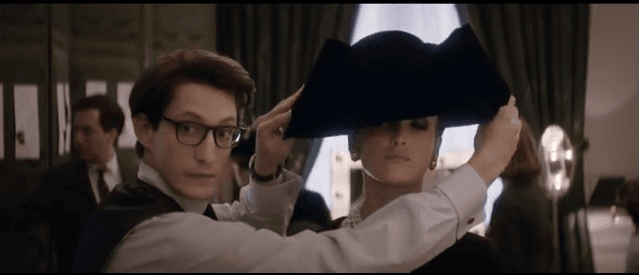
“Worst case, I’ll do my best.” That’s what YSL tells reporters when he takes over as artistic director at Christian Dior after Dior’s death. We’ll be forever grateful to him for it. I know I will!
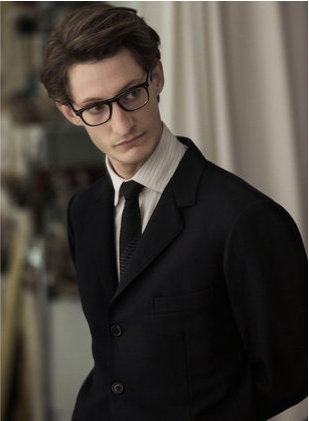
To understand what I thought of #YSL, you need to know a little about me.
You need to know that YSL’s runway shows have always moved me, shaken me, and filled me with wonder in a way no other great designer’s ever have. You need to know that I shed a few tears at his last show and was absolutely gutted (all over again) when he died.
To see why Pierre Niney is one of the best French actors working today, all you have to do is watch him play—or rather, embody, inhabit—his character in the biopic #YSL.
The film opens on a close-up of his shoulders and back as he bends over a drawing table in Algeria. His long, delicate hands sketch out designs. It’s 1957, and YSL is starting his career at Christian Dior.
We see Pierre Niney as a young, very young Yves Saint Laurent, before he became the man who upended the rules of fashion and changed women’s lives.
But very quickly, Pierre Niney disappears, and Yves Matthieu Saint Laurent takes over the screen, from his earliest days to his later years as a worn-out, ailing old man.
The gestures, the voice, the way he carries himself: he IS Yves Saint Laurent.
Of course, in several interviews he’s talked about the long months of work, the meetings with Pierre Bergé—in short, how he got to know the man he was going to play. An enormous personal commitment, no doubt, and real professionalism, for sure, but above all, an extraordinary talent.
Those familiar images of the well-behaved young man who would become such a provocative, controversial figure come to life. The photographs start moving before our eyes, from Pierre Boulat’s to Jean Loup Sieff’s.
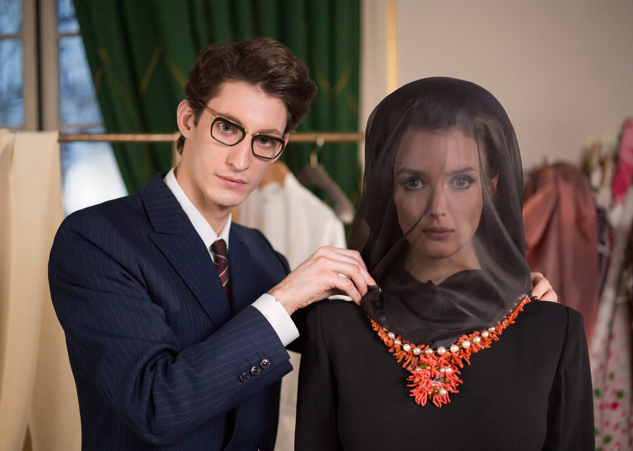
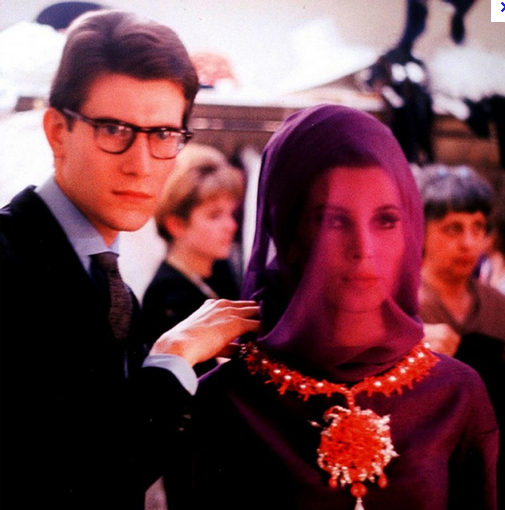
And then there are the runway shows: up there on the screen, we get to relive all those wonderful discoveries we admired over the years on TV and in magazines. Those glossy pages stir and come to life before our eyes, with the actual dresses, the ones so carefully preserved at the YSL Bergé foundation.
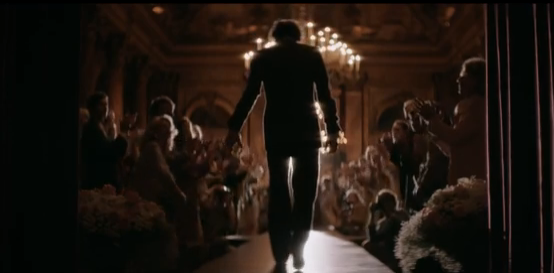
We feel the buzz of the backstage preparations, and we take a bow with him in front of rows of dazzled reporters.
I walked out of the movie with mixed feelings.
Blown away: by Pierre Niney’s talent (in case you hadn’t noticed, I’m a fan!).
Deeply moved: because, thanks to Niney’s talent and the quality of the footage of the runway shows and the work of this couture genius, I got to relive an extraordinary career in miniature, and above all, 40 years of fashion, fashion that changed with society but also helped speed those changes along.
Disappointed: by the film as a whole. The script all but disappears behind Pierre Niney’s performance and the runway footage. The other characters have no substance or depth and drift across the screen like extras. Only Charlotte Le Bon makes an impression as Victoire Doutreleaux, the star model and sexy, flirtatious friend.
And to wrap up, let me ask you this: why the voice-over?
Is it the cinematic equivalent of captions for the hard of hearing, or is it more about making absolutely sure we get what the film wants us to feel?
So instead of spelling out the background sounds or the noises things make, as captions usually do, they’re spelling out the feelings for us…
Romantic music… Yes, we get it: they’re falling in love, and you can feel the intensity.
Sound of a vase shattering… Ah, now things aren’t going so well!
YSL does a few lines… Right, we get it: he’s spiraling into excess and debauchery!
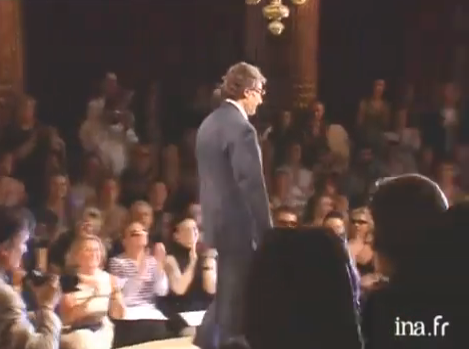
Here’s one of the last images from Yves Saint Laurent’s final show, as he walks down the runway once more, for the very last time. The film should have ended on that extraordinary shot, which is far more striking than the final words from Pierre Bergé / Guillaume Gallienne.