Van Gogh—Driven to Suicide by Life
There’s always something frustrating about temporary exhibitions at the Musée d’Orsay: you have to shut yourself away in a dark, windowless room when, just a few steps away, the old train station opens up into those extraordinary spaces, with majestic views of the Seine and the Louvre. Add to that the fact that the galleries are packed this Saturday morning—too packed, to the point where you have to squeeze between groups just to have a shot at reading the wall text between the paintings.
Luckily, you quickly forget these little annoyances as soon as the colors in the Dutch master’s paintings practically leap out at you.
What power! What violence! What beauty! Swirls of paint bring the sky and the wheat fields, the storms and the stars, the cypresses and the sunflowers to life.
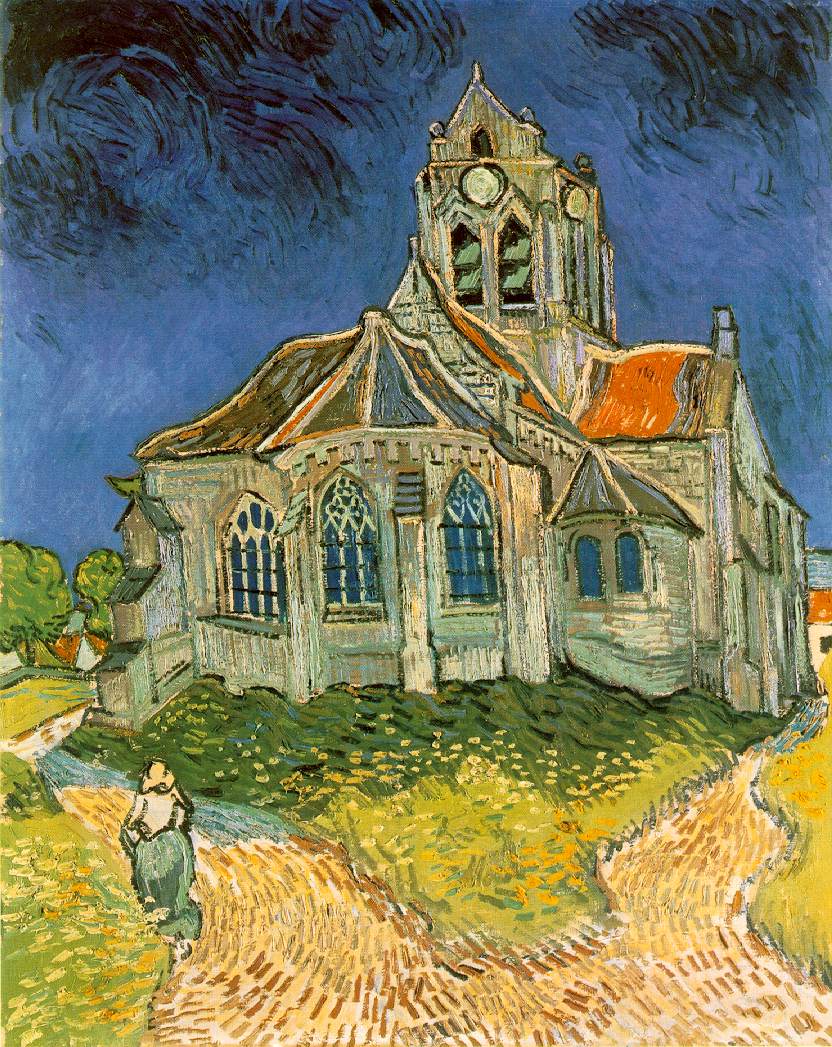
These paintings are as familiar as if they hung in our own living room, and yet it’s a delight to stand in front of the church at Auvers-sur-Oise, the bedroom in the Yellow House in Arles, the portrait of Dr. Gachet, and the poppy fields. There are also a few lesser-known paintings on loan from museums abroad, along with sketches and drawings.
But wait! Let’s not get carried away just gazing in bliss. This exhibition has a particular point of view. It isn’t just an exhibition about Van Gogh’s work; it brings two tormented lives face to face: that of the painter and that of the writer and theater artist Antonin Artaud. Artaud spent nine years of his life in psychiatric institutions, which arguably gave him some standing to write about Van Gogh—and he did. What does he tell us? That Van Gogh wasn’t really mad, that he took his own life because society drove him to the breaking point, that he was driven to paint himself to exhaustion in the face of a society that refused to see the truth he saw in the world. So Van Gogh, in Artaud’s view, was “driven to suicide by society.”
I’m not quite convinced by that reading. Did Van Gogh see truths in the world around him, in objects and faces, that escape us at first glance? Probably. But what does society have to do with it? Where exactly is the social criticism in Van Gogh’s work? Isn’t it life itself, and the absurdity of fate, that torments him? The work he produced over three years, from 1887 to 1890, is nothing less than one vast self-portrait, of his face and of his soul. A cry of despair and loneliness. Van Gogh wasn’t “driven to suicide by society”; he was “driven to suicide by life.”
Exhibition from March 11 to July 6, 2014
Musée d'Orsay
1, rue de la Légion d'Honneur, 75007 Paris
Written by: C Lui