TAKING SIDES – Théâtre Hébertot
“Do you like Beethoven? … Ah, that’s what I thought …”
Because he doesn’t like Beethoven. In fact, he knows nothing about music. He sells insurance in civilian life, a world away from the cultural circles of the man he’s about to question.
That’s why he was given the assignment. No emotional attachment, not a trace of artistic reverence for the man he has to question: the great German conductor Wilhelm Furtwängler.
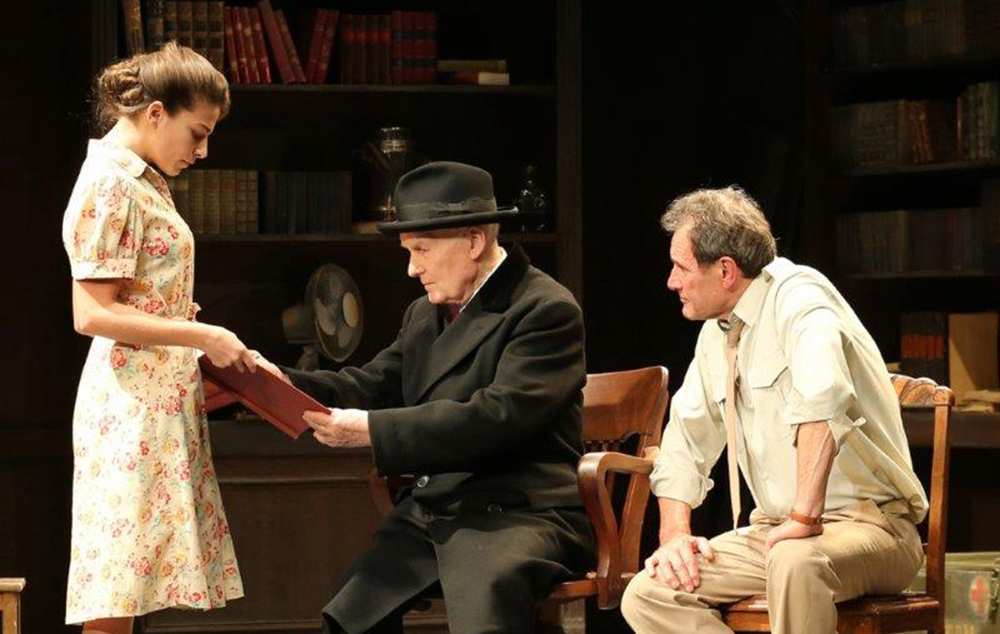
He’s American Major Steve Arnold (played by a convincing Francis Lombrail).
It’s 1946, and Germany is beginning its “denazification.” The major has just returned from the Eastern Front, where he helped liberate the camps. The experience shook him to the core. As far as he’s concerned, all Germans are now guilty. Guilty of seeing nothing, of doing nothing, and, for those who could have left, guilty of staying.
And Wilhelm Furtwängler did stay. He served the regime passively, without zeal but without resistance. He even conducted the Berlin Philharmonic in 1942 for Adolf Hitler’s birthday. Is he guilty? And if so, what is he guilty of?
Michel Bouquet lends his aging voice to the conductor, who puts every last ounce of strength into his defense. Art and music come before everything else. That’s his credo. “Art has nothing to do with politics. I wanted to keep that light alive so it could shine again once the nightmare was over,” says Furtwängler.
For two hours, the two men fight bitterly, and we still can’t decide: who’s wrong and who’s right? As in “Collaboration,” which dramatized the friendship between Richard Strauss and Stefan Zwieg, tainted by the war, playwright Ronald Harwood once again asks how artists behaved under the Nazis. Should they have fled or pursued their higher calling, to celebrate art, at any cost? When art becomes “official art” in the service of politics, doesn’t it lose its way in the dark?
A young man and a young woman help the American major with his investigation. They both love Beethoven, they both love music, and they both admire the conductor Wilhelm Furtwängler.
And yet …
He’s a young German Jew whose parents died at Auschwitz, and he now serves in the U.S. military.
She’s a young German woman, the daughter of a well-known opponent of Hitler.
In short, the people closest to the tragedy are the most forgiving.
It’s a little too obvious why the roles have been assigned this way.
The script may lack the subtlety it needs to be truly believable.
We see what’s at stake too quickly, and the rest of the play doesn’t tell us much more.
But that’s the thing about theater: sometimes the magic is tucked away in imperfect plays.
You get swept up in the power of the show and in the actors giving it their all, you applaud, you get to your feet …
That’s what I’ll remember about this play, and I’d urge you to go see it if only for the pleasure of watching one of the greatest French actors of our time onstage. And the actors playing opposite him more than hold their own!
Théâtre Hebertot 78bis Boulevard des Batignolles, 75017 Paris
Review co-written with C lui