Italian Cinema: A Revelation
It’s been about ten years since I had that revelation, and Marco Tullio Giordana shows once again just how powerful and sensitive Italian cinema can be.
For me, it all started with a film I saw alone one spring afternoon in a nearly empty theater, a film that left me shaken: “Bread and Tulips”. I discovered the joy of getting lost in another world, forgetting everyday life and savoring every minute of humanity those extraordinary actors brought to the screen. It’s a film where real life makes sense again, where you see that simple joys really do exist and that good people aren’t always where you expect to find them.
Then came a string of films, all of them looking at people with the same delicacy, depth and subtlety, a far cry from the forced black-and-white morality of blockbuster scripts. There was “My Brother Is an Only Child”, then “la Bella gente” and “Loose Cannons.”
But THE film that sets the bar for me, the one I turn to when the outside world starts to feel a little too heavy, is still, to this day: “The Best of Youth.”
It’s a sweeping portrait of 1970s Italy and a family saga, where History and family stories cross paths and intertwine to give us a great film, one with a wonderful sense of humanity.
It’s the film that introduced me to the most handsome Italian actor around right now—on a personal note, nobody should be allowed to be that good-looking, if you ask me—Riccardo Scarmaccio!
But it also introduced me to deeply human, sensitive characters whom the director never judges, following them instead with curiosity and even affection.
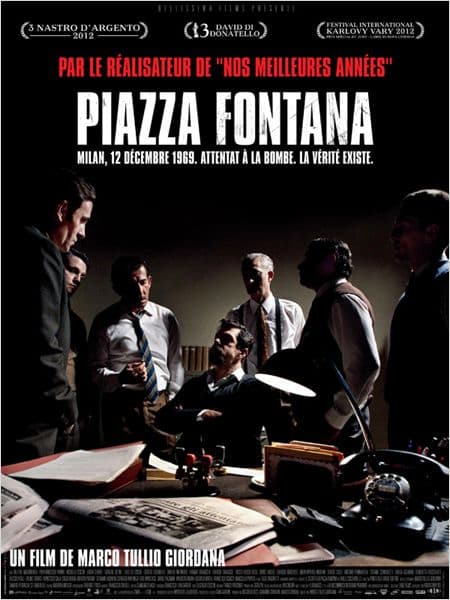
So “Piazza Fontana” comes from the same director as “The Best of Youth”: Marco Tullio Giordana.
As he told us himself at the screening, it’s a way of shedding new light on a tragedy that struck Italy in the middle of the Cold War.
For all the analysis and the wealth of writing devoted to the bombing, it went unpunished in the end: the justice system finally gave up.
The director told us he was just 200 meters from the site of the massacre that day in December 1969. And he added: “That doesn’t guarantee the film is any good, but it does guarantee it’s sincere!”
He was the father of Nicola and Matteo, the main characters in “The Best of Youth,” and now he’s added Pinelli and Calabresi to his gallery of portraits of Italy in that troubled era.
From the very first shots, the scene is set: the tension is palpable, you can feel that everything could explode, and in the end, it does. It’s the Cold War, with the Greek coup in the background, Italy on the verge of a coup of its own, and the country split among anarchists, Communists—whose party is the largest in Europe—and neo-fascists.
These small groups seem to be on opposite sides, but they’ve been infiltrated, and the lines between the extremes aren’t as clear as they might seem.
And then there’s the state, willing to make any compromise in the name of the so-called interests of the state.
At the heart of the tragedy are Pinelli, the anarchist, and Calabresi, the police commissioner, whose respect for each other is as mutual as it is unlikely.
Then comes the turning point, the moment when everything goes off the rails. Dozens dead, a police blunder, the search for a scapegoat.
Calabresi’s anguished cry: “non ero li! Non c'ero!” “I wasn’t there, I wasn’t there”.
Throughout the film, the director sets out to understand, without judging, without turning anyone into a caricature, without sorting people into good guys and bad guys.
In the end, he opens the door to another possibility: that the people who may have been responsible were quite different from those blamed at the time.
The film’s Italian title, “Romanzo Di una strage,” pays tribute to an article of the same name that Pasolini wrote in 1974 for corrière della sera.
Marco Tullio Giordana explains that Pasolini had figured it all out: the strategy of terror, and the fact that the people behind it weren’t necessarily the ones everyone imagined.
He says the title is a tribute to someone who understood what had happened without the evidence, evidence that came to light little by little.
Two bombs, and all the complexity of a situation, a country, a people.
Marco Tullio Giordana hopes to shed a little more light on this dark chapter in his country’s history.
He pulled it off!
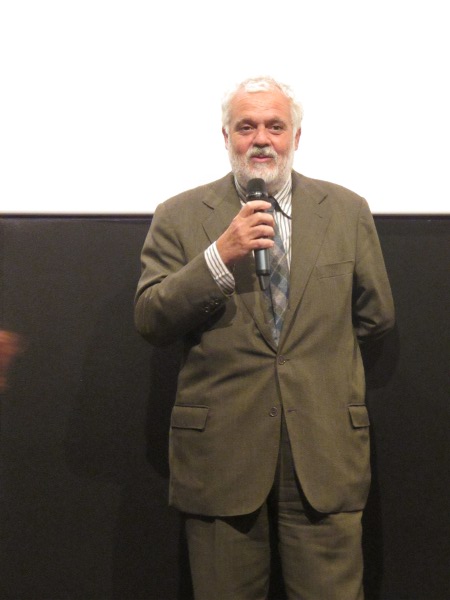
I want to thank Marco Tullio Giordana for being there, for his thoughtful remarks, and for his insights, always nuanced, smart, and sensitive. He’s given us a great film, and that’s rare enough to be worth celebrating!
So whatever you do, go see Piazza Fontana as soon as you can!
Opens November 28, 2012